AeroLearn Rwanda · Operational Procedures · Chapter 2 of 6
Commercial Air Transport Operations
How airlines are authorised, organised and supported — from the operator's approvals and aircraft status to crews, passengers, cargo, ground services and safety oversight.
Self-paced learningDetailed study chapter20-question assessment
How to use this chapter
Study each lesson in sequence. Pause at the examples and ask yourself what information is needed, who is responsible, which approved procedure applies and what must be recorded. Use each quick summary for revision, then complete the assessment without looking at the notes.
Educational material only. It does not replace approved training, current regulations, the aircraft flight manual, an operator's current Operations Manual or the judgement and authority of the pilot-in-command.
Commercial air transport (CAT) is not simply an aircraft flying from one airport to another. It is an organised activity in which an operator provides air transportation under a regulatory framework. The operation includes the aircraft, crew, operational control, maintenance arrangements, ground services, passenger and cargo processes, documentation, training and safety oversight.
1.1 What makes an operation commercial?
The central idea is carriage by air of passengers, cargo or mail for remuneration or hire. The exact legal definitions and exemptions are established by the applicable State's regulations. A flight may look operationally similar to a private flight but be subject to a different regulatory framework because of its purpose, commercial arrangement or the type of service offered.
Examples include scheduled passenger services, non-scheduled passenger charters, cargo services and certain specialised commercial operations. The label used by a company is not enough to determine the legal category: the actual activity and the applicable rules matter.
1.2 Scheduled and non-scheduled services
A scheduled service is generally published as part of a planned timetable and offered to the public or a defined market on a recurring basis. A non-scheduled service does not operate as a regular timetable service; charter flights are a familiar example. Both can involve commercial air transport, and both require the relevant authorisations.
Scheduled operations place particular emphasis on timetable integrity, network connections, aircraft rotations and passenger reaccommodation. Charter operations may involve changing destinations, customer requirements, short-notice planning and bespoke handling. Neither model removes the need for safe planning, current information and compliance.
1.3 The operator's scope and limitations
An operator may only conduct the kinds of operations for which it is authorised. The scope can be limited by aircraft type, operating area, route or aerodrome approvals, performance capability, crew qualifications, equipment, weather minima, operational specifications and conditions attached to the certificate or approval.
Operational thinking: Before asking whether an aircraft can physically fly a route, ask whether the operator is authorised to conduct that operation, whether the aircraft is approved and equipped for it, and whether the crew and supporting systems meet the applicable requirements.
1.4 Commercial objectives and the safety boundary
Airlines must manage cost, punctuality, customer service, aircraft utilisation and revenue. These are legitimate business objectives. They operate within a safety boundary: commercial pressure must not lead personnel to ignore defects, weather limitations, crew duty constraints, loading errors, required documents or approved procedures.
Good operational decisions often protect both safety and the business. A well-managed delay may prevent a larger disruption, protect the aircraft and crew, and preserve customer confidence. A departure made with unresolved safety-critical information can create far greater consequences.
1.5 International standards and national implementation
International civil aviation standards provide a common framework, but States implement requirements through their own legislation, regulations, approvals and oversight systems. Operators must identify the rules that apply to their State of the Operator, State of Registry, route, destination and any special authorisation.
Lesson 1 — quick summary
Commercial air transport is a regulated system for carrying passengers, cargo or mail for remuneration or hire. The operation must remain within the operator's authorisations, approved scope, aircraft limitations and applicable State requirements.
Lesson 2
The Air Operator Certificate and operational specifications
The Air Operator Certificate (AOC) is a central element of commercial air transport oversight. It demonstrates that an operator has been assessed against applicable requirements and is authorised to conduct specified operations. It is not a guarantee that every individual flight is safe, nor does it remove the operator's continuing duty to comply.
2.1 What an AOC establishes
An AOC identifies the authorised operator and establishes the broad basis on which commercial operations may be conducted. The accompanying operations specifications (often called Ops Specs) provide important detail about the scope and conditions of approval. These may address aircraft types, areas of operation, kinds of operation, special approvals and limitations.
2.2 Certification is an organisational assessment
Certification is not simply a check that an aircraft exists. The authority evaluates whether the applicant has the organisation and capability to operate safely and consistently. Depending on the applicable framework, assessment can include management structure, nominated postholders, operational control, manuals, training, maintenance arrangements, safety systems, facilities, personnel competence and financial or organisational capability where required.
2.3 Continuing compliance
Receiving an AOC is the beginning of continuing oversight, not the end of it. The operator must maintain the standards on which the approval was based. Material changes may require notification, acceptance or approval before implementation. Examples include changes to aircraft type, operating area, management personnel, contracted services, procedures or the scale and nature of the operation.
2.4 Reading the authorisation correctly
When reviewing an operation, do not rely on the certificate title alone. Confirm the exact operator identity, validity and conditions, the relevant operations specifications, any special approvals, and whether the planned flight falls within the authorised scope. A route may be commercially attractive but unavailable to the operator because of aircraft capability, route approval, crew qualification or aerodrome restrictions.
Example — a new destination: An airline wants to begin a service to a high-elevation airport. The planning team must not assume that an existing AOC automatically covers every relevant aspect. The operator needs to examine route and aerodrome authorisations, aircraft performance capability, crew training and qualification, operating minima, rescue and firefighting considerations, ground support and any required authority approval.
2.5 Responsibility cannot be outsourced by paperwork
An operator may contract maintenance, ground handling, training or other services. Contracting can allocate performance of a task, but it does not automatically remove the operator's regulatory accountability. The operator needs effective selection, agreements, communication, oversight and corrective-action arrangements for contracted services.
Lesson 2 — quick summary
An AOC is an authority-issued approval for defined operations, not a blanket permission. The certificate, operations specifications and associated approvals must be read together to understand what the operator may conduct and under what conditions.
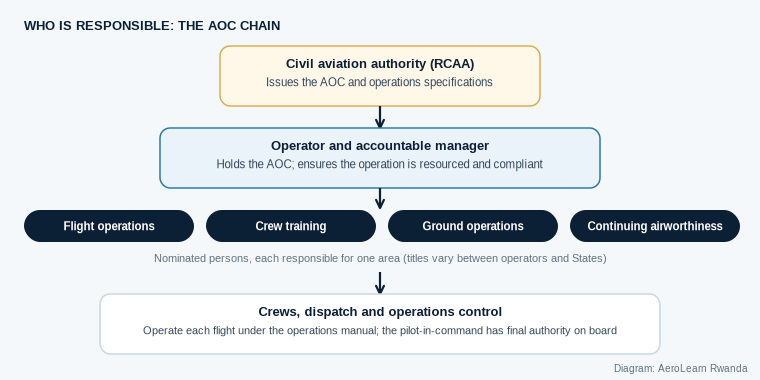
Who is responsible: the AOC chain. From the authority that issues the AOC to the crews who operate each flight. Diagram: AeroLearn Rwanda
Lesson 3
Aircraft, registration, airworthiness and operational availability
Commercial air transport depends on aircraft that are legally and technically suitable for the intended operation. Aircraft availability is therefore more than checking whether an aircraft is parked at the airport and appears serviceable.
3.1 Registration and identification
Registration connects an individual aircraft to a State's register and establishes the State of Registry framework. The aircraft carries the prescribed nationality and registration marks. Registration is distinct from airworthiness: registration identifies the aircraft within the State system, while airworthiness concerns its conformity and condition for safe operation.
3.2 Certificate of Airworthiness and continuing airworthiness
A Certificate of Airworthiness (C of A) is issued under the applicable system when the aircraft meets the relevant airworthiness requirements. Continuing airworthiness is the ongoing process of ensuring that the aircraft remains compliant and safe through maintenance, inspections, defect control, approved modifications and records.
A certificate should never be interpreted as proof that the aircraft has no defects today. The technical status must be assessed using the current technical records, defect reports, maintenance releases and the operator's procedures.
3.3 Technical log and defect management
The aircraft technical log is a controlled record used to communicate technical status and maintenance information. It may include flight details, defects, deferred defects, maintenance actions, release-to-service information and other required entries. The exact format and required content depend on the applicable system and operator.
A defect can be rectified, deferred under an approved process, or require the aircraft to remain grounded. Deferral is not an informal decision to ignore a problem. It must be permitted by the applicable approved data and procedures, commonly involving the Minimum Equipment List (MEL) where relevant, with any limitations, maintenance actions, placarding, operational procedures and rectification interval observed.
3.4 MEL and MMEL — different roles
The Master Minimum Equipment List (MMEL) is developed for an aircraft type under the applicable approval process and provides the basis from which an operator's MEL may be developed. The operator's MEL is tailored to its aircraft and approved or accepted as required by the authority. It identifies equipment that may be inoperative under specified conditions and the restrictions that apply.
Important: An MEL entry is not a general permission to dispatch with any defect. The exact item, aircraft configuration, operating conditions, required maintenance or operational procedures, and time limit must all be checked. If the defect is not covered or the conditions cannot be met, the aircraft must not be dispatched on that basis.
3.5 Aircraft configuration and equipment
Equipment requirements depend on the kind of operation, route, airspace, weather, aircraft category and applicable regulations. Navigation, communication, surveillance, warning, emergency, survival and cabin safety equipment may all be relevant. The operator must ensure that the aircraft is equipped for the intended route and conditions, not merely for a generic flight.
3.6 Operational availability decision
Aircraft availability is a coordinated decision. Flight operations may identify a suitable aircraft, but maintenance status, crew capability, loading, fuel, weather, airport conditions and required approvals must also align. An aircraft that is technically serviceable may still be unavailable for a particular route because of equipment, performance or approval constraints.
Lesson 3 — quick summary
An aircraft must be appropriately registered, airworthy, maintained, configured, equipped and released for the intended operation. A valid document does not excuse an unresolved defect or an aircraft configuration that is unsuitable for the planned flight.
Lesson 4
The commercial flight: people, passengers, cargo and ground services
The passenger or shipper sees a single airline service, but the operation is delivered by a network of departments and service providers. A failure in one link can affect the entire flight.
4.1 Passenger handling
Passenger processes include check-in, identity and travel-document checks, boarding, passenger counting, baggage reconciliation, special assistance and handling of irregularities. Passenger information must be accurate and communicated to the personnel responsible for load control and the flight deck as required.
Special categories may include unaccompanied minors, passengers requiring assistance, medical cases, deportees, inadmissible passengers, persons in custody and other categories governed by specific procedures. The operator's current manuals and applicable rules define acceptance, seating, escort, notification and safety arrangements.
4.2 Baggage and cargo
Baggage and cargo must be accepted, identified, screened and loaded in accordance with applicable procedures. Weight, distribution, restraint, segregation, compatibility and special handling requirements are important. Incorrectly loaded items can create both mass-and-balance problems and safety hazards.
4.3 Dangerous goods and special loads
Dangerous goods are articles or substances capable of posing a risk to health, safety, property or the environment and classified under the applicable dangerous goods framework. Acceptance, classification, packing, marking, labelling, documentation, loading, segregation and notification are controlled processes. Some dangerous goods are forbidden; others may be carried only under specified conditions.
Special loads can also include live animals, human remains, valuable cargo, temperature-sensitive goods, mobility aids, or other shipments requiring particular procedures. The operational team needs accurate information about the nature of the load and any associated restrictions.
4.4 Ground handling and aircraft servicing
Ground services can include marshalling, parking, chocking, ground power, air conditioning, fuelling, water and lavatory servicing, catering, cleaning, baggage handling, pushback and towing. These activities involve people and equipment moving around the aircraft, so clear coordination and communication are essential.
4.5 Fuelling and passenger safety
Fuelling arrangements must follow the aircraft, airport, operator and applicable regulatory procedures. When passengers are on board, embarking or disembarking, additional precautions and coordination may be required. Emergency exits and evacuation routes must remain usable, appropriate personnel must be available, and communication arrangements must be effective.
4.6 Turnaround coordination
A turnaround is a sequence of interdependent tasks. Some can happen in parallel, while others depend on completion of earlier steps. A realistic departure time requires visibility of the critical path, not merely a target time on a display. If a late baggage item, technical defect or passenger-count discrepancy appears, the relevant teams must resolve it before the aircraft is released.
Lesson 4 — quick summary
A commercial flight is delivered by many teams. Passenger handling, baggage, cargo, special loads, security, fuelling, catering, loading and dispatch must be coordinated through clear responsibilities and reliable information.
Lesson 5
Crew composition, qualification, training and fitness for duty
Commercial operations require competent personnel assigned to the correct roles. A flight cannot be considered ready simply because crew members have reported for duty.
5.1 Flight crew composition
The required flight crew complement depends on aircraft certification, the intended operation and applicable regulations. The operator's approved procedures establish crew composition, command arrangements, relief arrangements and any restrictions. The pilot-in-command (PIC) is designated in accordance with the applicable system and has command responsibilities for the flight.
5.2 Licensing and qualification
Each crew member must hold the licence, ratings, medical validity and other qualifications required for their assigned duties. Type ratings, instrument privileges, route or aerodrome qualifications, language proficiency and other endorsements may be relevant depending on the operation.
5.3 Recency and checking
Qualification is not only a matter of holding a licence. Operators must ensure that required recent experience, proficiency checks, line checks, simulator training and recurrent training are completed and valid. The precise intervals and requirements must be taken from current rules and the approved training programme.
5.4 Cabin crew
Cabin crew are responsible for passenger safety duties and other tasks assigned by the operator. Their duties include safety demonstrations and briefings, cabin preparation, monitoring the cabin, responding to abnormal and emergency situations, and coordinating with the flight deck. Service duties must not compromise safety duties.
5.5 Fitness for duty
Crew fitness includes physical and mental readiness, fatigue management, illness, medication effects, alcohol and psychoactive substance restrictions, and the ability to perform assigned duties safely. A crew member who is unfit must use the appropriate reporting process. Operational pressure must not discourage honest reporting.
5.6 Flight and duty time limitations
Flight and duty time limitation (FTL) systems are designed to manage fatigue risk. They address matters such as duty periods, flight time, rest, standby, positioning and cumulative limits. Exact figures and calculation methods vary with the applicable State framework and approved scheme. Historical JAR-OPS tables should be studied as historical examples, not copied into current rostering decisions.
Dispatcher's perspective: Crew legality is a planning condition. A delay, diversion, aircraft change or extended duty can affect whether the assigned crew may continue. The operator needs a process to reassess legality as the operation changes.
Lesson 5 — quick summary
The operator must ensure that crew members are qualified, current, appropriately assigned and fit for duty. Minimum crew numbers, licence privileges, type qualifications, recency, training and duty limitations are determined by current applicable requirements and approved procedures.
Lesson 6
Operational control, command and organisational accountability
Operational control connects the operator's organisation with the conduct of each flight. It defines who may make or approve operational decisions, what information must be considered, how the flight is monitored and how changes are managed.
6.1 The operator's operational-control system
The system can include flight planning, crew assignment, dispatch or flight release processes, flight following, weather and NOTAM review, communication with the crew, escalation of abnormal situations, diversion support and record keeping. The detailed allocation of authority differs between States and operators.
6.2 Pilot-in-command
The PIC has command responsibility for the aircraft and the safe conduct of the flight in accordance with applicable law and the operator's procedures. The PIC must assess information available to the flight crew, operate within aircraft limitations, exercise judgement and respond to changing circumstances. The PIC's authority must not be confused with the operator's organisational responsibilities.
6.3 Flight Operations Officer / Flight Dispatcher
ICAO Annex 6 describes the role of the flight operations officer/flight dispatcher in supporting and assisting the PIC and providing ground supervision, subject to the system established by the State and operator. Tasks can include assisting with flight preparation, preparing or assisting with the operational flight plan, providing relevant information, monitoring the flight and supporting the PIC when conditions change.
The dispatcher is not automatically the commander of the aircraft. Nor should every task described in an older JAA textbook be assumed to apply identically in every State. The legal authority, licensing or qualification requirements, shared responsibility model and dispatch-release process must be confirmed against current national requirements and the operator's approved manual.
6.4 Communication and escalation
Operational control depends on timely, accurate communication. A report of deteriorating weather, a technical issue, a closed runway or a crew duty concern must reach the people able to act. Escalation procedures identify when a routine update becomes a safety concern requiring management attention or a decision by the PIC.
6.5 Decision-making under pressure
Operational decisions often involve incomplete information and competing demands. A sound process identifies the hazard, verifies facts, considers the applicable limits and options, consults the correct authority, communicates the decision and records it. The objective is not to eliminate every delay; it is to make a defensible decision within the safety and regulatory framework.
Lesson 6 — quick summary
Operational control is the operator's system for initiating, conducting, continuing, diverting or terminating flights within the applicable framework. It must be distinguished from the PIC's command authority and from the support duties assigned to dispatch or flight operations personnel.
Lesson 7
Manuals, records, compliance monitoring and safety management
Commercial aviation depends on a documented and controlled system. Personnel need access to current instructions, and the operator needs reliable evidence that procedures are being followed and problems are corrected.
7.1 Operations Manual
The Operations Manual (OM) contains the operator's policies, instructions and procedures relevant to its operations. The historical study structure describes Part A (General/Basic), Part B (Aircraft Operating Matters), Part C (Routes and Aerodromes) and Part D (Training). That structure is useful for understanding the range of subjects that an operator manual must address, but the current manual format and required content must be checked against the applicable authority requirements.
7.2 Manual control
A manual is only useful if it is controlled. The operator needs a process for approval or acceptance where required, revision, distribution, access, acknowledgement, withdrawal of obsolete copies and communication of urgent changes. A crew member using an outdated procedure may make a decision based on information that is no longer valid.
7.3 Operational records
Records may include flight plans, load and trim documentation, technical log extracts, journey logs, weather and NOTAM information, special-load notifications, fuel records, crew duty records and reports. The exact records, retention periods and storage methods depend on current requirements and operator procedures.
7.4 Compliance monitoring
Compliance monitoring checks whether the operator meets applicable requirements and follows its own approved procedures. It can include audits, inspections, sampling, findings, corrective actions and follow-up to confirm that the action worked. A finding should be analysed for its cause and operational significance rather than closed with a superficial correction.
7.5 Safety Management System (SMS)
An SMS is a systematic approach to managing safety, including organisational structures, accountabilities, policies and procedures. It includes hazard identification, safety risk assessment, risk controls, safety assurance and promotion. It is intended to identify weaknesses before they lead to harm and to improve the organisation's safety performance over time.
7.6 Relationship between compliance and safety
Compliance and safety management are related but not identical. Compliance asks whether a requirement is being met. Safety management asks what hazards exist, how risk is controlled and whether controls are effective. A compliant process can still contain hazards that deserve attention; a safety report may identify a risk even when no rule has been broken.
Lesson 7 — quick summary
Controlled manuals tell personnel how the operator intends the operation to be conducted; records provide evidence of what happened. Compliance monitoring checks conformity, while safety management identifies hazards and manages risk. These systems should work together.
Lesson 8
Commercial performance, disruption and service recovery
Airline operations are exposed to weather, technical defects, air traffic flow restrictions, airport closures, crew availability, security events, late passengers, baggage issues and network disruption. The response must preserve safety while managing the effects on the wider operation.
8.1 The operational impact of delay
A delay can affect aircraft rotations, crew duty limits, connecting passengers, curfews, slots, ground handling and maintenance plans. A seemingly small delay on one sector may create a significant network effect later in the day.
8.2 Prioritising decisions
When disruption occurs, establish the facts first. Determine whether the issue affects safety, legality, aircraft serviceability, crew legality, airport availability or customer service. Identify the decision-maker, the relevant procedure and the available options. Avoid making promises before the operational facts are known.
8.3 Diversion, cancellation and return to stand
These are operational outcomes, not simply customer-service decisions. A diversion may be necessary because of weather, technical status, medical events, fuel considerations, runway conditions or other hazards. Cancellation may be the safest or only lawful option if a suitable aircraft, crew or operating environment is unavailable. Returning to stand may be required when a defect or loading discrepancy is identified before departure.
8.4 Communication with passengers
Passenger communication should be prompt, factual and consistent with the confirmed operational situation. Avoid speculation about technical causes or estimated departure times that have not been validated. Operational teams should coordinate what can be communicated and when updates will be provided.
8.5 Learning from disruption
Disruption reports can reveal recurring weaknesses: poor handovers, unrealistic turnaround plans, unreliable supplier performance, repeated technical issues or inadequate information flow. The organisation should review significant events and recurring patterns, then implement and verify corrective action.
Lesson 8 — quick summary
Commercial operations must manage disruption without allowing punctuality or customer pressure to override safety. Effective recovery depends on accurate status information, clear authority, realistic options and communication with passengers and operational teams.
Applied learning
Integrated operational cases
Case 1 — A charter request outside the approved scope
A customer requests an urgent charter to an airport not previously used by the operator. The aircraft appears suitable and the customer is willing to pay a premium.
Analysis: Commercial urgency does not establish authority. The operator must confirm the AOC scope and operations specifications, route and aerodrome suitability, aircraft performance and equipment, crew qualification, handling support, permits and any special approval. If a required approval is absent, the flight cannot proceed on the assumption that it will be resolved later.
Case 2 — An aircraft with a deferred defect
During pre-flight preparation, a crew member notices that an item of equipment is inoperative. A colleague says the same defect was accepted yesterday.
Analysis: Yesterday's acceptance is not proof that today's dispatch is permitted. Confirm the aircraft identity and configuration, technical log entry, applicable MEL item, operational and maintenance procedures, rectification interval and any limitations. If the defect is not covered or a condition cannot be met, do not dispatch under that deferral.
Case 3 — A late special-load notification
A cargo team reports a special shipment after the initial load plan has been prepared. The shipment requires special handling and may affect loading restrictions.
Analysis: Stop and establish what the shipment is, its classification and documentation, whether it is permitted, where it may be loaded, segregation and restraint requirements, and what notifications are required. Update load control and the flight crew as required. A late commercial request does not justify loading without complete information.
Case 4 — Crew legality changes after a delay
A technical delay extends the duty period. The crew is willing to continue because passengers are waiting.
Analysis: Recalculate crew legality using the current approved FTL scheme and actual duty events. Consider extensions only where expressly permitted and correctly authorised. If the crew cannot legally or safely continue, arrange replacement crew, delay or cancellation. Willingness to continue does not override fatigue rules.
Revision
Chapter 2 — summary and key takeaways
Commercial air transport is a coordinated, regulated service. The AOC defines the authorised scope; aircraft and crews must be suitable; passengers, cargo and ground services must be managed correctly; and operational control, manuals, records and safety systems must support every flight.
Revision framework
Explain what makes a flight commercial air transport and distinguish scheduled from non-scheduled services.
Describe the relationship between the AOC, operations specifications and special approvals.
Explain registration, airworthiness, continuing airworthiness, technical logs, MEL and MMEL.
Draw the passenger, baggage, cargo and ground-handling chain for a typical turnaround.
Explain crew qualification, recency, fitness for duty and fatigue limitations.
Compare the responsibilities of the operator, PIC and FOO/FDO.
Explain how manuals, records, compliance monitoring and SMS complement one another.
Reference
Technical glossary
Term
Meaning
AOC
Air Operator Certificate: authority-issued authorisation for defined commercial air transport operations.
Ops Specs
Operations specifications setting out the scope, conditions and special approvals associated with an operator's authorisation.
CAT
Commercial air transport: carriage of passengers, cargo or mail for remuneration or hire, as defined by applicable law.
C of A
Certificate of Airworthiness issued under the applicable airworthiness system.
Continuing airworthiness
Ongoing processes that keep an aircraft compliant and airworthy throughout its operational life.
Technical log
Controlled aircraft record for technical status, defects, maintenance actions and required operational entries.
MEL
Minimum Equipment List: operator-specific approved/accepted list and conditions for dispatch with specified equipment inoperative.
MMEL
Master Minimum Equipment List: type-level basis from which an operator's MEL is developed.
PIC
Pilot-in-command: designated pilot with command responsibility for the aircraft and flight.
FOO/FDO
Flight Operations Officer / Flight Dispatcher, whose duties and authority depend on applicable rules and operator procedures.
SMS
Safety Management System: systematic organisational approach to managing safety risks.
FTL
Flight and Duty Time Limitations: rules and approved schemes intended to manage fatigue risk.
Special load
Cargo, baggage or other load requiring additional handling, documentation, notification or operational controls.
Compliance monitoring
Processes used to assess conformity with regulations, approvals and operator procedures.
Knowledge check
Chapter 2 assessment — 20 original questions
1. What is the defining feature of commercial air transport in general terms?
2. Which statement best describes an AOC?
3. What should be checked alongside an AOC to determine the operator's permitted scope?
4. Which statement about outsourcing ground handling is most accurate?
5. What is the key distinction between registration and airworthiness?
6. An aircraft has an inoperative item. What is the correct first reference for dispatch under a deferral?
7. Which statement about an MMEL is correct?
8. Which is an example of a commercial operation that may be non-scheduled?
9. Why must a late special-load notification be assessed before loading?
10. What is the purpose of crew recency and recurrent checking?
11. Which statement about flight and duty time limitations is correct?
12. Which role normally has command responsibility for the aircraft?
13. Which statement best describes the FOO/FDO role?
14. What is the principal function of an Operations Manual?
15. What does compliance monitoring primarily examine?
16. How does SMS differ from compliance monitoring?
17. A new destination is high elevation. What is an essential operational consideration?
18. A crew member reports being unfit for duty. What is the appropriate response?
19. A delay threatens crew legality. What must operations do?
20. Which is the best principle when communicating disruption to passengers?
Source notes
Further study
Operational Procedures — used for the commercial air transport and operator framework, aircraft/technical status, flight operations roles, manuals and operational records.
Source boundaries: These are historical JAA/JAR-OPS and EU-OPS era training references. The chapter explains their concepts in original language and does not present old thresholds, time limits, equipment requirements or legal wording as current Rwandan rules. Current operations must follow RCAA requirements, applicable State rules, approved operator manuals and current operational information.
This chapter is educational. It is not an AOC approval, aircraft release, legal interpretation or substitute for approved operator training.